
AI vs AI: The Invention of GANs
Goodfellow et al. (2014)
Goodfellow, I., Pouget-Abadie, J., Mirza, M., Xu, B., Warde-Farley, D., Ozair, S., ... & Bengio, Y. (2014). Generative adversarial nets. Advances in neural information processing systems, 27.
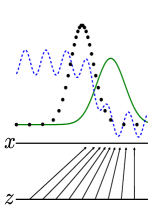
In 2014, Ian Goodfellow and colleagues introduced a framework for generative modeling based on a minimax game between two competing neural networks. Prior to this research, the generation of complex data such as images required difficult probabilistic estimations or the use of restrictive architectural assumptions to capture the underlying data distribution. The researchers demonstrated that realistic synthetic samples can be produced by training a generator network to deceive a discriminator network, which simultaneously learns to distinguish real from fake data. This shift moved generative AI from explicit density estimation toward a system of emergent complexity driven by the structural tension of opposing objectives.
The Minimax Game and Adversarial Training
The core technical mechanism of the paper is the adversarial framework, which formalizes the relationship between the generator () and the discriminator () as a zero-sum game. The generator is tasked with mapping random noise into synthetic samples that are statistically indistinguishable from the training data. The discriminator is trained to maximize the probability of assigning the correct label to both real examples and those produced by its opponent. As the discriminator becomes more proficient at identifying forgeries, the generator receives a differentiable signal - a gradient - that guides it to adjust its internal parameters to produce increasingly higher-fidelity samples. This finding proved that the most effective way to teach a machine to create is to provide it with an automated evaluator that can identify its specific failures.
Gradient-Based Optimization without Density Estimation
A primary technical advantage of generative adversarial networks is their ability to learn without the need for an explicit probability density function. Traditional generative models often required the calculation of complex integrals or approximations like Markov Chain Monte Carlo (MCMC) to evaluate the model's likelihood. By framing the problem as a game where the discriminator provides the optimization signal, GANs bypass these computational bottlenecks. This methodological choice allowed for the training of models on high-dimensional datasets with significantly lower mathematical overhead. It established that the appearance of structural order can emerge from the iterative refinement of a model's output in response to external feedback.
Training Dynamics and the Nash Equilibrium
Despite the success of the framework, the research revealed fundamental challenges in maintaining the stability of the minimax game. The training process requires the system to reach a Nash equilibrium where neither network can improve its performance relative to the other. If the discriminator becomes too accurate early in the process, the gradients provided to the generator can vanish, preventing further learning. Conversely, the system may suffer from mode collapse, where the generator identifies a narrow subset of data that consistently fools the discriminator, leading to a loss of diversity in the generated output. These instabilities suggested that the efficiency of an adversarial system is highly sensitive to the balance of power between its competing components.
Impact on High-Fidelity Synthesis and Data Augmentation
The practical significance of GANs is evidenced by their rapid adoption in computer vision and media synthesis. By providing a scalable method for producing sharp, realistic images, the technology enabled applications ranging from high-resolution medical imaging to automated data augmentation for autonomous systems. This application proved that the scalability of generative models depends on the adoption of architectures that prioritize competitive feedback over top-down statistical definitions of quality. The work effectively digitalized the act of synthesis, proving that the complexities of visual reality can be reconstructed through the systematic management of adversarial gradients.
Competitive Optimization as an Intelligence Primitive
The success of this work demonstrated that many complex optimization tasks can be resolved through the persistent application of conflicting local constraints. The decision to model generation as a structural competition revealed that high-level capabilities can emerge from the interplay of simple, opposing rules. This principle remains central to modern research into multi-agent systems and the development of more robust alignment techniques for large language models. It leaves open the question of whether true artificial intelligence requires a top-down logical design or if it is an emergent property of the persistent tension found in adversarial environments.
Dive Deeper
Generative Adversarial Nets (Official arXiv)
arXiv • article
Explore ResourceGenerative Models (OpenAI Blog)
OpenAI • article
Explore ResourceIan Goodfellow Interview (MIT Tech Review)
MIT Tech Review • article
Explore Resource
Discussion
0Join the discussion
Sign in to share your thoughts and technical insights.
Loading insights...
Recommended Readings
The author of this article utilized generative AI (Google Gemini 3.1 Pro) to assist in part of the drafting and editing process.