
Mixtral and the Power of Sparse Experts
Jiang et al. (2024)
Jiang, A. Q., Sablayrolles, A., Roux, A., Mensch, A., Savary, B., Bamford, C., ... & Lacroix, T. (2024). Mixtral of experts. arXiv preprint arXiv:2401.04088.
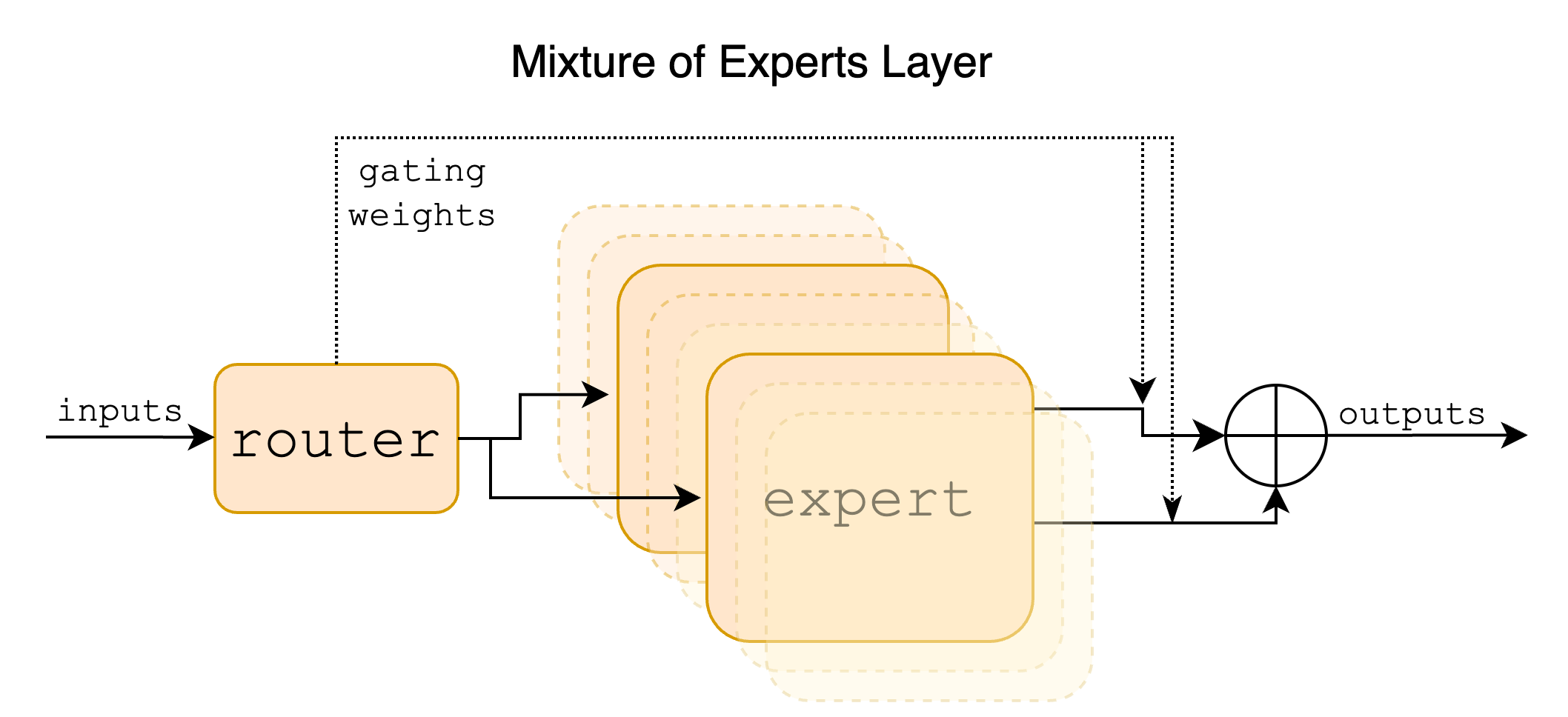
The 2024 Mixtral of Experts paper by the Mistral AI team introduced a shift from dense transformer architectures toward sparse scaling. In standard dense models, every parameter is activated for every token processed, which creates a significant computational cost for larger systems. Mixtral addresses this by using a sparse mixture-of-experts architecture where only a subset of parameters is active for any given calculation. This allows for a massive knowledge base while maintaining the inference speed and latency of a much smaller system.
The architecture replaces standard feed-forward blocks with a mixture-of-experts layer. For every individual token, a routing network identifies the two most relevant experts out of eight to process the data. This selective activation allows a 47-billion parameter model to use only 13 billion parameters during inference. This decoupling of total capacity from active compute requirements suggests that scaling can be achieved by organizing parameters into specialized units that are only called when necessary. It marks a move away from the assumption that intelligence requires the full weight of a network for every piece of information.
The efficiency of this approach is shown by Mixtral's ability to match the performance of much larger dense models while operating at a higher speed. This finding indicates that a model's knowledge can be distributed across a sparse array of units that are activated strategically. The bottleneck in previous AI designs was the inefficiency of activating all parameters for every calculation regardless of the task's complexity. By allowing the system to route its way through an internal network, researchers have achieved significant performance gains without a corresponding increase in computational cost.
Research into the specialization of these experts revealed that their roles are primarily syntactic rather than domain-specific. Instead of individual experts handling topics like math or philosophy, they tend to specialize in handling structural roles, such as specific grammatical patterns or keywords. While this sparse approach reduces the mathematical work needed for inference, it does not reduce memory requirements, as the entire model must still be stored in VRAM. This creates a trade-off between computational efficiency and memory capacity that defines the current limit of model democratization.
The future of sparse models will likely depend on how hardware can be redesigned to store and access inactive knowledge more effectively. As architectural constraints become more pronounced, the focus of engineering may shift from the processor to the memory bus. Mixtral's success proves that sparse activation is a viable path for scaling artificial intelligence, but it also highlights the physical challenges of managing massive knowledge bases. The development of more sophisticated routing and storage mechanisms remains a central theme in the pursuit of efficient intelligence.
Dive Deeper
Mistral AI Blog: Mixtral
Mistral AI • article
Explore ResourceMixtral MoE Paper (arXiv)
arXiv • article
Explore Resource
Discussion
0Join the discussion
Sign in to share your thoughts and technical insights.
Loading insights...
Recommended Readings
The author of this article utilized generative AI (Google Gemini 3.1 Pro) to assist in part of the drafting and editing process.