
The Foundation Model for Every Pixel
Alexander Kirillov et al. (Meta AI, 2023)
Kirillov, A., Mintun, E., Ravi, N., Mao, H., Rolland, C., Gustafson, L., ... & Girshick, R. (2023). Segment anything. arXiv preprint arXiv:2304.02643.

In 2023, researchers at Meta AI introduced the Segment Anything Model (SAM), a foundation model for computer vision designed to perform zero-shot image segmentation across a near-infinite variety of objects and environments. This research addresses the fragmentation of the segmentation field, where earlier models were trained for specialized categories - such as medical imaging or autonomous driving - on relatively small, manually labeled datasets. The researchers demonstrated that by defining a "promptable" segmentation task and training on a dataset of over 1.1 billion masks, a system can learn to identify any object based on a simple point, box, or text prompt, establishing a universal tool for visual decomposition.
The Promptable Segmentation Task and Real-Time Decoding
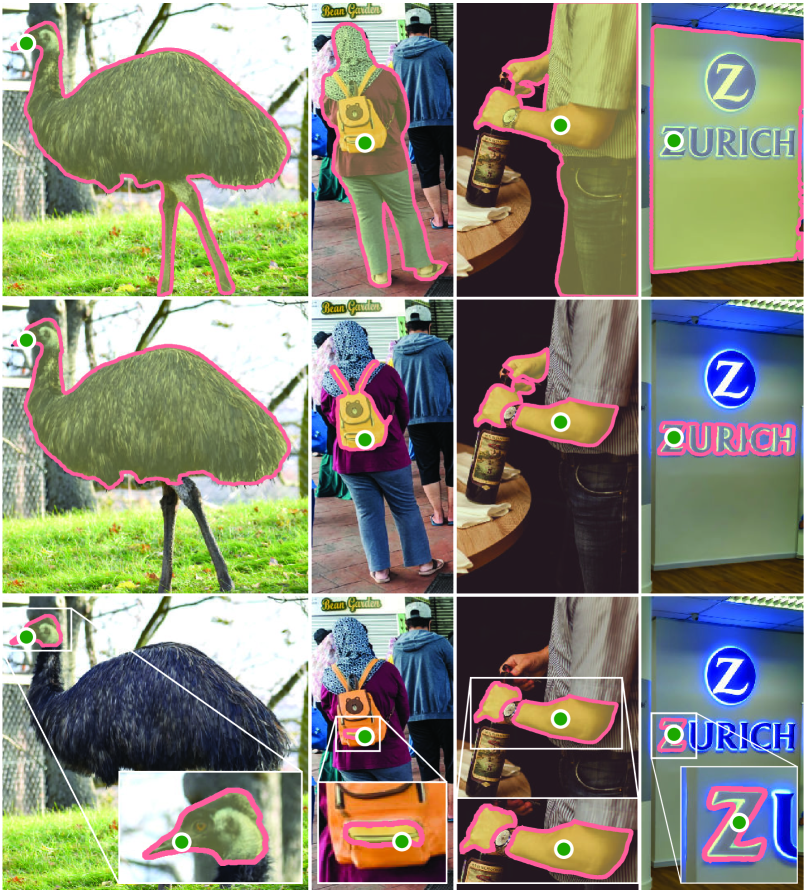
The primary technical contribution of SAM is the separation of the generative process into a heavyweight image encoder and a lightweight, promptable mask decoder. The image encoder, based on a Vision Transformer (ViT), processes the input image once to extract a rich set of visual features. The decoder then utilizes these features to generate a precise segmentation mask in real-time (under 50ms) based on user-provided prompts. This architectural shift proved that the "seeing" phase of vision can be decoupled from the "deciding" phase, allowing for an interactive system where the model's output is steered by human intent without the need for redundant feature computation.
The SA-1B Data Engine and Model-Assisted Labeling

To achieve universal performance, the researchers developed the SA-1B dataset through a three-stage "data engine." The process began with human annotators using the model to assist in labeling, followed by a semi-automatic stage where the model identified common objects and humans labeled the remaining difficult ones. In the final stage, the model was utilized to automatically generate over a billion high-fidelity masks across 11 million images. This methodological choice revealed that the bottleneck in AI data collection can be bypassed by using the model itself to scale its own intelligence. It established the principle that the most successful foundation models are those that can participate in the recursive refinement of their own training data.
Zero-Shot Generalization and Domain Independence
The technical significance of SAM was validated through zero-shot evaluation across 23 diverse segmentation benchmarks, ranging from cell microscopy to underwater photography. Without any task-specific fine-tuning, SAM outperformed many specialized models, demonstrating that the ability to identify object boundaries is a fundamental visual primitive that generalizes across all domains. This finding established that "intelligence" in segmentation is a structural property of the model's exposure to diverse visual topologies rather than a result of category-specific optimization. It proved that a single foundation model can effectively replace an entire ecosystem of specialized vision tools.
Impact on Augmented Reality and Scientific Analysis
The practical significance of the Segment Anything Model is evidenced by its adoption in fields such as medical imaging, ecological monitoring, and video editing. By providing a scalable method for isolating objects from their backgrounds, SAM enabled the development of tools that can analyze complex visual scenes with minimal human oversight. This application digitalized the act of visual selection, replacing manual tracing with an automated, responsive feedback loop. The work transformed image segmentation from a static classification task into a dynamic, intent-aware component of the broader AI reasoning stack.
The Logic of Universal Visual Extraction
The success of SAM demonstrated that the most robust way to process visual information is to ensure that the model remains responsive to external constraints. The decision to prioritize promptability revealed that the primary constraint on computer vision was the rigidity of fixed-category outputs. This principle remains the central theme in current research into multi-modal extraction and the development of more advanced spatial reasoning models. It leaves open the question of whether the next leap in visual understanding will require the integration of 3D depth information or if the 2D topological priors of SAM are sufficient for universal perception.
Dive Deeper
Segment Anything Project (Meta AI)
Meta AI • docs
Explore ResourceSAM Paper on arXiv (Preprint)
arXiv • article
Explore ResourceSA-1B Dataset Description
Meta AI • docs
Explore ResourceInteractive SAM Demo
Meta AI • website
Explore Resource
Discussion
0Join the discussion
Sign in to share your thoughts and technical insights.
Loading insights...
Recommended Readings
The author of this article utilized generative AI (Google Gemini 3.1 Pro) to assist in part of the drafting and editing process.